


The Importance of Joint Movements and Warm-Up in Yoga Practice
Why Warming Up Isn't Optional
It's tempting to think of yoga as inherently gentle — and therefore safe to walk straight into without preparation. But this assumption overlooks something important: many yoga postures ask joints and muscles to move through ranges they rarely experience in daily life. Sitting at a desk, driving, or walking covers only a fraction of the body's full range of motion. Stepping directly into deep stretches, twists, or balancing postures without first preparing the body is one of the most common — and most avoidable — causes of yoga-related strain and injury.
Warming up isn't a formality tacked onto the beginning of practice. It's the mechanism that makes everything that follows both safer and more effective.
What's Actually Happening in the Body
A cold body and a warmed-up body behave very differently, for clear physiological reasons:
Synovial fluid needs movement to do its job. Joints are lubricated by synovial fluid, which thickens when the body is still and thins out — becoming more effective at reducing friction and cushioning the joint — once movement begins. Gentle joint rotations before deeper postures help this fluid circulate properly, reducing stiffness and unnecessary wear.
Muscles and connective tissue become more pliable with warmth. Cold muscle fibers and fascia are stiffer and more resistant to stretch; attempting a deep stretch before this warming occurs increases the risk of micro-tears or strain. A gradual increase in body temperature and blood flow allows tissue to lengthen safely and more fully.
Circulation needs to catch up with demand. Warm-up movements increase heart rate and blood flow gradually, delivering oxygen to muscles before they're asked to work hard — easing the transition rather than shocking the system.
The nervous system needs a moment to engage. Warm-up also serves a neurological role: it activates the mind-body connection, sharpening proprioception (the sense of where your body is in space) before balance postures or more complex movements are attempted.
Why Joint Movements Specifically Matter
Within a warm-up, joint rotations and mobilizations deserve particular attention — more so than they're often given.
Joints are frequently the weakest link. Muscles are generally more adaptable and forgiving than the ligaments and cartilage surrounding a joint. Injuries in yoga far more often show up at the knees, wrists, shoulders, and lower back — all joint-heavy areas — than in the muscle bellies themselves.
Full range of motion needs to be "woken up" deliberately. Many joints, especially wrists, ankles, hips, and shoulders, aren't moved through their complete range during an ordinary day. Postures like Downward Dog, deep lunges, or arm balances ask these joints to bear weight or move fully almost immediately — without preparation, this is where strain tends to occur.
Joint mobility directly enables deeper postures. Tight hips restrict seated forward folds; limited shoulder rotation limits backbends and arm balances; stiff ankles affect standing balance postures. A short, deliberate sequence of joint rotations — neck, shoulders, wrists, spine, hips, knees, ankles — opens the door to safer, more complete expression of postures later in practice.
A Simple Joint Warm-Up Sequence
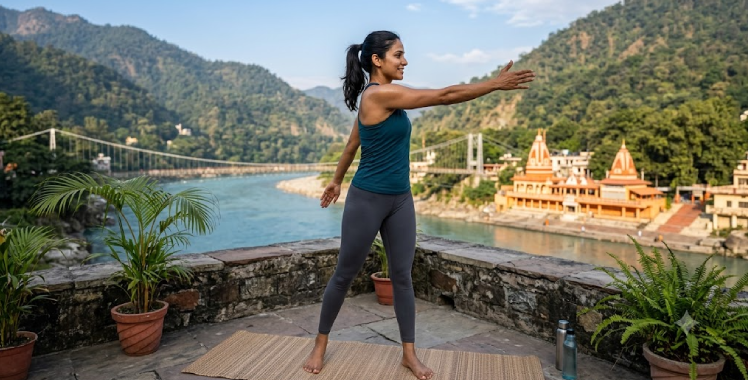
A traditional and widely used approach, often called pawanmuktasana (joint-freeing series) in classical hatha yoga, moves systematically through the body:
- Neck — slow nods, side-to-side tilts, and gentle rotations
- Shoulders — rolling forward and backward, loosening the shoulder girdle
- Wrists — circular rotations and gentle flexion/extension, especially important before any weight-bearing poses
- Spine — seated or standing twists, cat-cow movements to mobilize each vertebral segment
- Hips — hip circles, figure-four stretches, gentle hip openers
- Knees — small circular movements with care, since knees are hinge joints not designed for large rotational stress
- Ankles — rotations and flexing/pointing, supporting balance and standing postures
Spending even five to seven minutes moving through this kind of sequence before the main practice makes a measurable difference in how the rest of the session feels.
The Difference It Makes in Practice
The benefits of proper warm-up and joint preparation show up in several concrete ways:
- Reduced injury risk — tissues and joints that have been gradually prepared handle load and stretch far better than cold ones.
- Greater range of motion — postures that feel restricted at the start of practice often open up naturally once the relevant joints have been mobilized.
- Better body awareness — a brief warm-up re-establishes the connection between attention and sensation, making it easier to notice when a posture is being pushed too far.
- A calmer transition into practice — warm-up movements, done slowly and with breath awareness, also serve as a bridge from the scattered pace of daily life into the more focused state yoga asks for.
Important Notes
- Warm-up should be slow and exploratory, not rushed. The goal is gentle mobilization, not a workout in itself — small, controlled movements are more effective than large or forceful ones.
- Pay extra attention to areas of known tightness or past injury. A joint or muscle group with a history of strain deserves more time and gentler progression, not less.
- Breath should stay steady throughout. Coordinating movement with slow, even breathing isn't incidental — it's part of what shifts the warm-up from mechanical stretching into genuine yogic practice.
Skipping warm-up to "save time" usually costs more time later. An injury serious enough to interrupt practice for days or weeks, caused by rushing into a session cold, is a poor trade for the few minutes a proper warm-up requires.