


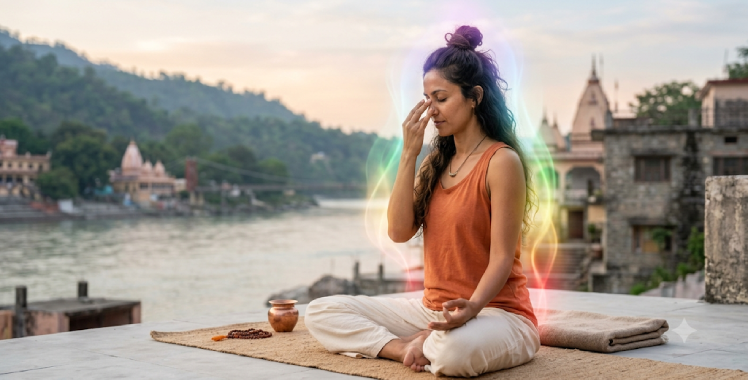
Pranayama for Chakra Balancing: Using Breath to Restore Harmony
The Bridge Between Breath and Energy
In the yogic tradition, breath is never just a physiological act — it's considered the most direct and controllable link between the body and the subtler dimensions of our being. The word prāṇāyāma itself reveals this: prāṇa (vital life-force) and āyāma (to extend, draw out, or regulate). Pranayama, then, is the deliberate regulation of life-force through breath.
Chakras — the seven primary energy centers running along the spine from the base to the crown — are understood as hubs where prāṇa concentrates and circulates. When this flow is smooth and balanced, we experience clarity, vitality, and emotional steadiness. When it's blocked or erratic, the corresponding chakra is said to become either underactive (sluggish, depleted) or overactive (agitated, excessive). Pranayama works on the premise that by consciously shaping the breath — its depth, rhythm, pause, and direction — we can directly influence this energetic flow and bring a stuck or chaotic chakra back toward balance.
This isn't a stretch within yogic philosophy — it's central to it. Long before physical postures (āsana) became yoga's public face, breath regulation was considered one of the most powerful tools for working with consciousness itself, precisely because breath is the one autonomic function we can also control at will.
Why Breath Specifically?
A few reasons pranayama is considered such a precise tool for chakra work:
- Breath is always present. Unlike mood or thought, which shift unpredictably, breath is continuous and directly observable — giving a stable "handle" to work with.
- Breath reflects inner state. Anxiety shortens and raises the breath into the chest; grief catches it in the throat; anger makes it sharp and forceful. Because mental and emotional states show up in breath patterns, changing the pattern can, in turn, shift the state.
- Breath can be directed. Through visualization combined with specific breathing techniques, practitioners direct the sensation of breath toward a particular center of the body — effectively using attention and respiration together as a single tool.
A Pranayama Practice for Each Chakra
What follows pairs each chakra with a pranayama technique traditionally associated with its qualities. These aren't rigid prescriptions — different lineages vary in their pairings — but they represent widely used approaches.
1. Root Chakra (Mūlādhāra) — grounding, stability, security
Technique: Dirga Pranayama (three-part breath)
Slow, deep breathing that fills the belly, ribs, and chest in sequence, then releases in reverse. The lengthened, grounded quality of this breath mirrors the root chakra's need for stability and physical presence. Practicing seated with awareness at the base of the spine reinforces the connection.
2. Sacral Chakra (Svādhiṣṭhāna) — creativity, emotion, fluidity
Technique: Chandra Bhedana (left-nostril breathing)
Inhaling only through the left nostril (associated with the cooling, lunar, receptive quality) and exhaling through the right. This technique is traditionally linked to emotional balance and the flowing, watery quality associated with this center.
3. Solar Plexus Chakra (Maṇipūra) — willpower, confidence, transformation
Technique: Kapalabhati (skull-shining breath)
Short, forceful exhales from the lower belly with passive inhales, generating heat and energizing the core. This fiery, activating breath mirrors the solar plexus's association with personal power and digestion — both literal and metaphorical.
4. Heart Chakra (Anāhata) — love, compassion, connection
Technique: Nadi Shodhana (alternate nostril breathing)
A balancing, even-ratio breath alternating between nostrils, said to harmonize the subtle energy channels (nāḍīs) on either side of the body. Because the heart chakra sits at the midpoint of the chakra system — the bridge between the lower, physical centers and the upper, mental ones — this balancing technique suits its integrative role.
5. Throat Chakra (Viśuddha) — communication, truth, expression
Technique: Ujjayi Pranayama (victorious/ocean breath)
A slight constriction at the back of the throat creates an audible, oceanic sound on both inhale and exhale. The physical engagement of the throat directly stimulates this chakra's location and is traditionally associated with clarity of expression.
6. Third Eye Chakra (Ājñā) — intuition, insight, focus
Technique: Bhramari (humming bee breath)
A gentle humming exhale with ears softly closed, creating an internal vibration felt in the head and brow. This technique is widely used to quiet mental chatter and turn attention inward — qualities associated with the third eye's role in intuitive perception.
7. Crown Chakra (Sahasrāra) — transcendence, unity, pure awareness
Technique: Kevala Kumbhaka (natural breath retention)
A spontaneous, effortless pause in the breath — not forced, but arising naturally as the mind settles into stillness. This connects to the crown chakra's association with a state beyond ordinary mental activity, echoing the stilled-mind state described in Patanjali's own definition of yoga (citta-vṛtti-nirodhaḥ, Sutra 1.2).
Important Note
A few practical and honest points worth keeping in mind:
- Start gently, especially with forceful techniques. Kapalabhati and other activating breaths aren't suited to everyone — pregnancy, high blood pressure, and certain respiratory or cardiac conditions warrant caution or avoidance. When in doubt, consult both a qualified yoga teacher and a physician.
- Chakra theory sits outside mainstream physiology. It's a traditional energetic model, not an anatomical one. Approaching it with genuine curiosity rather than literal medical expectation tends to be the healthiest frame.
- Consistency over intensity. A few minutes of steady, attentive practice daily tends to shift breath patterns — and reportedly, energetic ones — more reliably than occasional long sessions.
Sensation over belief. You don't need to accept the chakra model philosophically to benefit from the breathing techniques themselves; the physiological effects (calming the nervous system, improving focus, regulating mood) are well documented independent of the energetic framework layered on top.